
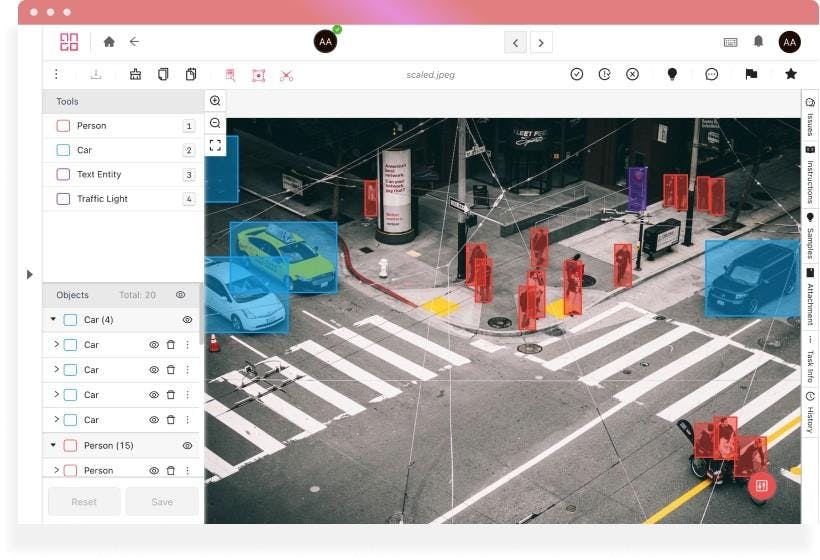
Understanding Motion with AI-Driven Video Data
Video annotation extends image annotation by adding the dimension of time, allowing AI models to track movement, identify patterns, and understand interactions across frames. This helps systems analyze real-world scenarios more effectively.
Core Annotation Capabilities
- Object Tracking: Follow objects across multiple frames.
- Action Recognition: Identify human activities and behaviors.
- Frame-by-Frame Labeling: Annotate each frame for precision.
- Event Detection: Recognize specific actions or incidents.
- Multi-Object Tracking: Handle multiple moving elements simultaneously.
Video Annotation Use Cases
- Autonomous Driving for tracking vehicles and pedestrians.
- Security & Surveillance for detecting suspicious activities.
- Sports Analytics for performance tracking and insights.
- Retail Analytics for customer behavior analysis.
- Healthcare for movement and activity monitoring.
With accurately annotated video datasets, AI systems can learn temporal patterns and improve decision-making in real-time scenarios.
Video annotation enables machines to not just see — but understand movement, behavior, and time.
Advanced Video Intelligence Solutions
By combining video annotation with deep learning and computer vision, organizations can build systems capable of real-time tracking, predictive analysis, and automated monitoring. These technologies are driving innovation in industries that rely on dynamic visual data.
